Tuesday, June 18, 2013

Una Mariposa Social

I had a very social weekend. The highlights included:

My coworker had a baby shower on Saturday that was well attended with Peruvians and ex-pats alike (as well as stocked with delicious Belgian beer, since the hosts were Belgian!). The godmother had recommended a recycled toy store near my apartment for gift shopping, where I found an adorable stuffed book named "Don Cuadrado". I showed up an hour "late", which apparently was quite early. Most people started to show up about 3 hours after the time on the invitation. It's amazing how much more I feel like a type A personality here than I do in the US.

On Sunday, I was invited to a practice for the Peruvian Ultimate team. Which was a TON of fun, but also I am super out of shape (and, you know, recovering from my latest silly ankle injury). The lexicon is still really dominated with English, but I'm learning some relevant spanish words (mantiene la fuerza!). And it's taking me a while to get used to stalling in Spanish. They play twice a week, so I'm looking forward to having a regular activity to do here!


I also finally had time and was healthy enough to run on the bike path along the coast for the first time, which was breathtaking.


My coworker also says he might have an extra bike I can use for a month, so hopefully soon I can take coastal bike rides too!

Foggy skyscrapers
I also ran through the Parque del Amor, which is designed to mimic Gaudi's style.

A pic of me on my first visit to the park a week earlier!
It features huge statue of a couple kissing that is supposed to glow orange when the sun sets (at least in the summers when there is sun).


Like all parks here, it is a popular spot for couples. Peruvian couples LOVE parks. In Guatemala couples would escape to public parks because they could, ahem, express emotion without their families overseeing anything.

Yup, I'm a creeper...
Further down they had a park that had flower bed replicas of the Nasca Line designs.

Said park in the summer sunshine
Beyond the lush green and the sight of the cliffs, my favorite feature is the ubiquitous bougainvillea flowers that overhung the cliffs. You really can see why my neighborhood is called Miraflores (get it??? mira + flores??).

Look at them.
At the office this morning, I went through my first sizable Peruvian earthquake! It was a 4.5 that originated in Chile. So it was a lot weaker when it hit here, but you could definitely feel it and everyone made a run for the doorways as the shocks hit. Everyone spent most of lunch talking about the earthquake in 2007, in which one girl literally saw waves move down the major road she was standing on when it hit.

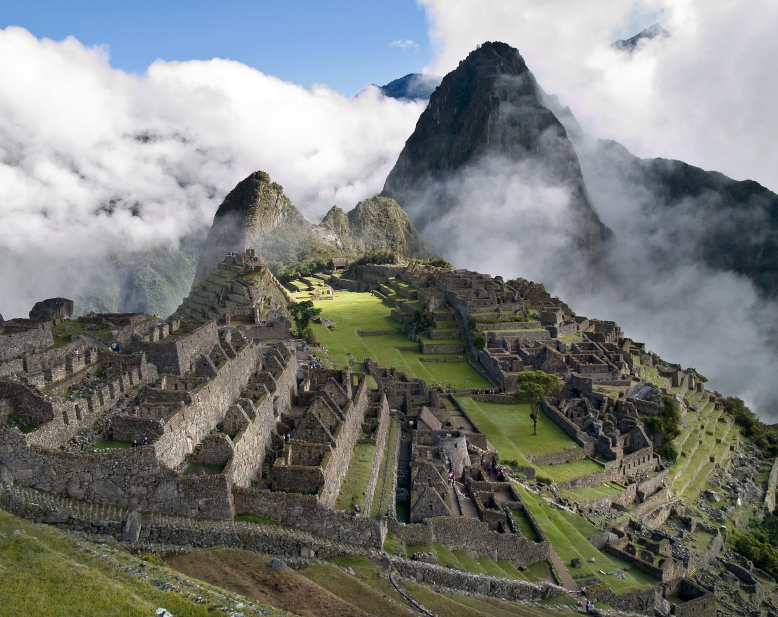
The biggest excitement (other than natural disasters) is that I leave for Cusco tomorrow! Namely, I am 3 days away from THIS:
(photo credit: http://www.peru-machu-picchu.com/)
I hope blogger can handle the impending slew of photos that are going to be posted upon my return.

A Plethora of Spiritual Riches

I got a tip to go out to the east end of Pueblo Libre to check out the anthropology museums. Convinced, I could walk to the Museum without really knowing where it was, I ended up covering a lot of ground by foot (like 5+ miles). But I finally found the Larco Museum.

Entering the museum
The first two rooms when you enter are dedicated to the museum's founding family. Rafael Larco Herrera was given a collection of archaeological artifacts from his brother-in-law, Victor, and left them all to his son, Larco Hoyle. Victor had already opened the first museum in Lima and he urged Larco to set up a new museum to house all of these pieces and begin to bring together a larger collection of artifacts. Larco was eager to create a monument in honor of his father, so he bought a number of private collections and in the 1920s, he opened his museum in an old Viceroyal building that had been built on top of a 7th century pre-Columbian pyramid.

The courtyard of the museum/house
As Larco begin to set up the museum and classify this acquired collection, he realized how few categories existed to classify Peruvian artifacts. Within a decade, he had documented a number of new Peruvian cultures, and developed the first Peruvian chronology of ancient cultures: a chronology that is still used today. Larco also developed new techniques to determine the age of artifacts based on their placement in ancient structures, as well as developed an early core sampling technique.

The museum is broadly divided into his own chronology. I am going to apologize now for not remembering which things belonged to which cultures specifically, but most of these things are from the coastal and mountain regions in the northern half of the country, with the final stuff being mostly Incan.

Given the dependence on agriculture by these ancient societies, the earth was seen to be composed of three "worlds": the sky (the source of rain), the land (which had to be worked), and the subterranean world (where the dead went to and where the fruits of the earth came from). Each of these were represented by an animal: the bird (often an owl), the feline, and the serpent (or also sometimes the spider), respectively. Representations of deities most often included these animals.

The three animals were often combined in pottery. For instance this shows the body of a bird combined with the feet of a feline and the tail of a serpent.
As early as 1000 BC, these societies were producing beautiful and complex pottery. These challenging shapes and constructions involved multiple laborious steps and often would take days to produce.

These two animals playing show how fluidly the movement of these deer were portrayed, as though you could see them moving (thought to be from 1-100 AD). Also, they are adorable.
In addition to portraying the three dominant animals, there was also a strong motif of the balance of good and evil, represented through darkness and light.


As you can see above, a number of pieces existed within this theme. Because there was no paint used at this point, these were done using the "negative" painting technique that I mentioned before (as opposed to a "positive" technique of painting or putting something on the finished piece). Again, they would cover the part they wanted to stay white with a heavy clay and bake the entire piece with the clay on it. This would preserve the parts under the clay as white, allowing shading without using any dyes or paint.

Another unique aspect was that there were also pots that portrayed real people. Rather than do portraits of powerful men (always men), they would create likenesses in pottery. Only if you were an elite, of course.


With the Spanish conquest, a lot of Andean art incorporated European influences such as using lead- and mineral-based glazes for the first time. Also, it was common for Pre-Colombian art to show a feline god attacking a deer, or a person carrying a subdued deer on their back to demonstrate their god-like strength. However, with the Spanish conquest, you began to see pieces that showed the feline figure subdued for the first time.

A subdued feline being carried by a powerful man. Doesn't take much to read into the meaning of this symbolism.
The three animals were also present in textiles. Can you find the feline, serpent and owl in this?
Human sacrifice was definitely also a big presence throughout the museum. Lots of ceremonial bowls and costumes for both the victims and overseeing priests. 

Ceremonial owl bowls made of silver
There were a ton of Incan gold and silver artifacts as well, as you can imagine. While silver and gold were used in pieces of art, it wasn't the minerals that were valued, so much as the effect. The only things in nature that are associated with light are valued resources such as water and sunlight. Therefore, artifacts that also reflected light were seen to be connected to Gods as well. The elites then had lots of shiny accessories to wear, because if shined like the sun or the river, you must hold God-like power.

It was common during the Incan empire for elites to be buried with miniatures like this, made out of silver, copper of gold.
Because it was really the effect of shiny-ness that was important and not the minerals themselves, they would make a mixture of metals with just enough gold or silver to shine brightly. So when you actually look at how much gold and silver are in a collection like this, it doesn't actually come to much. After the Spanish conquest, when the conquistadores began to melt down these pieces of art and jewelry for booty. In the end, they actually did not end up with that much gold and silver. The mineral riches that brought Spain the most wealth were actually acquired through extensive mining. So in the end, all of those Incan artifacts were destroyed for nothing...

Silver alloy necklace that would have been worn by an elite.

Similarly quartz was valued, and was used in jewelry.

These shells were very valuable as well and sometimes even used for currency in Incan societies. However, this practice faded away once the Spanish arrived and established a new currency that centered exclusively around minerals instead of shells.

This is the largest and most complete set worn by an elite that exists in Peru. In addition to the pieces above, elites would also wear large nose rings, often large enough to obscure the bottom half of their face.

My favorite part was honestly the storage area. You finish going through the museum and were like, WOW. That was quite the collection! And then you turn a corner and there is room after room after room with tons of art, categorize by subject. And most of them are in great condition. Suddenly the collection gets a whole lot more impressive.
I finished up the day checking out the Colonial surroundings.

Colonial-era town hall

A bust of Simón Bolivar in the town square. Bolivar is a figure you see pop up again and again. After all, he was THE emancipator of South America.

The old church in the center of Miraflores.


Friday, June 14, 2013

Pre-Incan Roots

I managed to catch quite the nasty cold last week, and I even had to stay home from work for part of Thursday and Friday, but by Saturday midday, I really needed to get out of the apartment. I decided to go check out one of Lima's pyramids. Lima is named after one of the early societies to settle in this area.

The pyramid from the main Plaza.

The Lima people started building around 200 AD, and they were later taken over by the Wari around 600 AD. This was all before the Incas conquered most of the region in the 1400s.


Huaca Pucllana, the name of the pyramid, was the religious and ceremonial center of the Lima complex, which also included a grand plaza, administrative buildings, and homes of the elite. Most other people lived in the surrounding area in less auspicious structures. Lima was a great place to settle because it had the freshwater source of the Rimac river and the ocean for fishing nearby.

A view of Miraflores on the way up

Lima is also susceptible to earthquakes, so it was initially a difficult place to build larger structures. Incredibly, the Lima architects developed a technique of stacking bricks in alternating diagonal structures, giving the pyramid a flexible reinforcement when earthquakes shook the structure. They also stacked bricks in alternating patterns horizontally to give it more flexibility. The new techniques meant that they could continue to build a larger pyramid around the smaller one that already stood. 

I didn't manage to get a photo of the diagonal structures, but it is sort of visible at the bottom of this shot...

Most pyramid tombs in the other cultures are hollow to allow access to those who are buried, but the Lima pyramids are solid throughout the structure. This is because they were build over time, and thus solid layer was build over solid layer. Therefore as you excavate each layer you would discover a new slew of tombs from that period.

A tomb from the Wari period

The tombs they that have excavated (only about a third of the pyramid has been excavated and is open to visit) show burial of people with their livelihoods. Weavers were buried with yarn, potters with pottery, etc. The pyramid continued to grow even after the Wari took over so there is a mixing of Wari and Lima style tombs. The points of transition is what mostly has allowed archaeologists to have a clear idea of when the Wari assumed power in the area.


Beyond the actual pyramid, there was also a sample farm and animal enclosure that showed the dominant crops and animals that these societies cultivated.


There was your typical Peruvian fare like beans, corn, coca, and wheats. As well as Andean ducks, llamas and al pacas. Llamas are apparently larger than al pacas, so they were used as pack animals, whereas al pacas were exclusively used for their fur and milk. There was also cotton plants that grew various hues of orange and red cotton that were used for weavings. Unfortunately, they weren't in bloom so I couldn't get a picture of it.


There was very few dyes and paints used in Lima and Wari weavings, pottery and architecture. The only evidence of a dye that has been found is a mineral-based yellow dye that was thought to have covered the entire pyramid at its height. This was also used for pottery, but more common was painting with a "negative" technique, which involved covering parts of the pots as they were heated, creating a lighter coloring on the protected surfaces.

The upper plaza that is thought to have been the site of human sacrifices.

Human sacrifice was also thought to be a regular event, and this upper plaza was used for most of the ceremonies. It is thought that most of the tombs in the lower plaza were sacrifice victims and regular burials were conducted elsewhere.


It's been really fun to learn about the long list of societies that rose and fell before the Spanish arrived. Huaca Pucllana is just one of many pyramids and structures that survive in the area, and one of the few that has a dedicated excavation ongoing. They are slated to start a few others, but there are just too many. As recently as 2012, they discovered the remains of a new set of ruins while digging for the structure of a new building. That begins to show you why Peru is labeled one of the world's "cradles of civilization".

Next up: Pre-colombian artifacts and more archaeological history

Monday, June 3, 2013

Vecina Miraflores

I am now officially a resident of Lima city! I moved into my depa (apt) on Saturday and have since been settling into my new digs.

My new place is on the west side of Miraflores, a mere 2 blocks from an ocean-side park. If I had to choose a long-term place to live here, this place would almost be it Pictures are at the end of the post!

After a weekend of getting things in order, I think I finally am set up at home. I spent most of Saturday and Sunday (when I wasn't getting supplies) exploring the neighborhood. 

If you walk north from my place, there is a plaza with almost entirely American establishments that I rarely visit, which is a bit weird. McDonald's. KFC (which is very popular here), TGIFridays, Chili's. Starbucks (with valet parking, I might add). Which I actually do go to because free wifi! There as also even an authorized iStore for Apple products. The only non-American venue is the grocery store, Wong's. I don't know if it's just because I'm a foreigner, but people always seem to describe stores to me in terms of what origin its owners are. And people always want to point out the Chinese, Arab, and Jewish stores the most. I was expecting more Japanese stores, considering the large Japanese population in Peru, but I have yet to see any other than the occassional sushi bar.

However getting away from Ovalo Americano, if you head east, the neighborhood is full of great things to do. I just joined the neighborhood listserve which has a ton of free events, from art shows to plays to movie screenings. And crazy enough, most of it is free. There's even a Mario Vargas Llosa tour that you know I'm going to have to do. And there is public art almost everywhere.


On Sunday, a friend of my mom's was in town and suggested we go down to the beach to the fish market for lunch. While the Humboldt current results in a plethora of sardines in the waters around Lima throughout the winter (making Peru one of the biggest sardine exporter in the world), most of the fishing is actually done near the Chilean border. 


Chorrillos is an entirely artisan fishery. These fishermen ride 7-9 hours EACH WAY to get to their fishing sites. Given that Peru-Chile border waters is such a draw for both Peruvian and Chilean fishermen, there is a big risk of overfishing. They said that there is always a plethora of coast guard ships around to ensure that no one crosses the maritime border to fish in the others' waters, and one can only hope that the regulations in place for overfishing are effective as both nationalities try to fish as much as they can before the fish cross the border. I asked, but no one had an answer for me other than "there is some kind of agreement."


Chorriilos sells a staggering array of fish (I only got a pic of a smaller stand, but it has sea urchin!). In addition to a fish market, there is also a bunch of resturants where you can eat fresh fish on the beach. We tried a spicy fish soup called Parihuela, which was good, but we but were disappointed when they held back the spice for us gringas. Probably some of the freshest fish I've had though.


Any leftover fish were fed to eager Pelicans.


We took a boat ride into the ocean to see some more of the coast, but we mostly only saw the grey coastline that is a constant during winter, and the uneventful private sailing club next door. 


Also as you can kind of see below, the pelicans and seagulls hang out on the boats when they aren't being used to sunbathe. They say being pooped on is good luck, and given the level of bird poop I saw on them, these boats are really lucky.


There is a big conference this week that I am headed to, so I'll be busy again, but I have already started to plan out weekend activities to FINALLY see some of Lima's famous museums. Also I'm hoping to do a day trip to nearby ruins either this weekend or next!

Pictures of my new home:
My front door from the patio (I'm on the left)

My slightly messy living room


My kitchenette. I'm getting really good at cooking with a hot plate. At least it has a super nice espresso maker.

My bedroom.. As you might be noticing, it was hard to get photos of entire rooms. Also since this photo, I invested in a down blanket and I have never been happier with a purchase.

This is the best part, my own little garden in the back!